Featured Post

Framing the Issue of the Digital Divide in Education

Showing posts with label education. Show all posts

Wednesday, March 14, 2018

Online Learning and the Digital Divide: Benefits and Cautions

In 2003, the U.S. Dept. of Education reported that 317,000 students took online courses.  In 2015 that number jumped to 2.7 million students and continues to grow.  Different schools use online learning for different reasons:  some for enrichment, some for variety, and some simply to meet essential skills where teachers are simply not available.  It is this third case that is most relevant to equity and digital divide issues.  In rural Mississippi, students take AP Physics classes from an instructor hundreds of miles away.  In rural Oregon, students learn Spanish from a teacher who appears digitally while a proctor facilitates the classroom.  In suburban and urban areas across the U.S., districts employ online coursework for a variety of reasons, with a big push to use digital coursework to make up academic credit.


For small schools -- particularly those in rural areas with few students and staff -- online learning can mean opportunity.  Subjects that could only be taught at large urban and suburban schools can now be accessed from afar.   This can be a game changer with respect to equity and online learning can provide opportunities that were inconceivable just a few years ago.  Additionally, online learning can offer several advantages:


A.  Convenience -- the resources are available from anywhere and at any time.

B.  Independence -- in some cases, students can set their own hours of learning.

C.  Variety -- districts can expand their course offerings to match student need and interests.

Despite these benefits, there are certainly cautions as well:

A.  Lack of human interaction -- many high school online courses rely on reading and test taking formats with no human interaction.  The lack of consistent teacher feedback can be a barrier to those students who very well might need consistent interactions the most.   Although these types of courses might meet the needs of some students, many students experience perceive them as drudgery.

B. Lack of ownership -- when districts purchase online courses, they give up lack of control and over content and instruction.  Some courses might be a "general" fit, but the static course does not allow for adaptability. 

C.  Lack of connectivity -- when districts rely on online materials and instruction without planning for home connectivity, it is the poorest students who might end up having the least access.  

D.  Lack of Data -- currently, the data doesn't always support the efficacy of online learning, and some providers have been accused creating lackluster courses motivated mainly by profit.

E.  Cost -- in many instances, online work can cost more as a supervising teacher is working with fewer students and the district still has to pay the content provider a fee for their service.

As outlined in a Hechinger Report article, online learning does have potential.  It can provide opportunities for advanced coursework where opportunities never existed, and this is especially true for students in rural areas.  However, districts must exercise due diligence in vetting coursework.  When there is a live teacher involved in the online learning process, the potential for student engagement and deeper learning is much greater.   With respect to the digital divide, districts must also consider connectivity issues for all students.   Otherwise, implementing coursework that requires home study for students who don't have internet access will magnify inequities and set students up for failure.

Friday, November 17, 2017

Equity vs. Equality in the Digital Divide

Equity vs. Equality in the Digital Divide


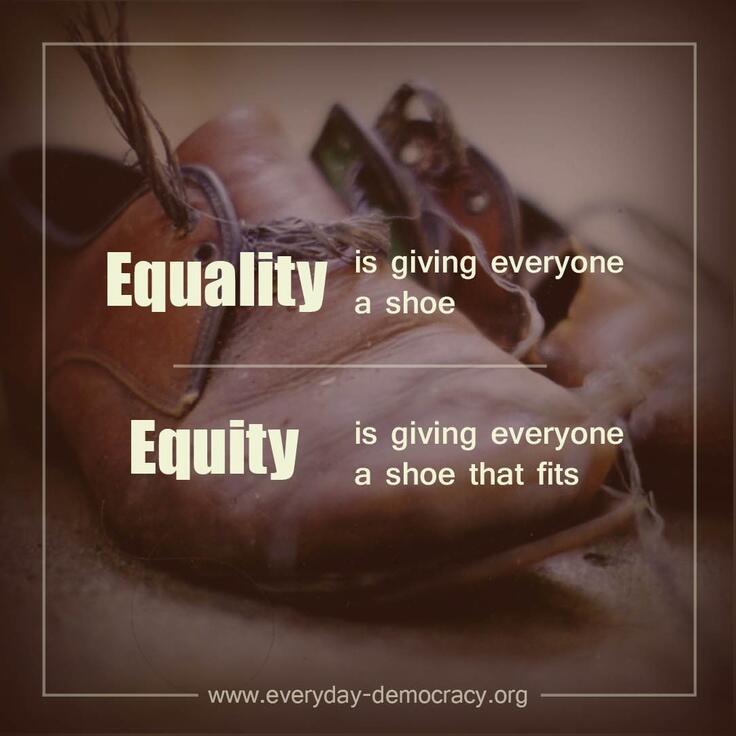
bzml8pgceaaprab-jpg-large.jpgIn most states, school funding formulas are fraught with politics and this has significant implications for technology infrastructure, devices, and opportunities.  The urban vs. rural digital divide surfaces in most states, especially as it relates to connectivity.  Many rural schools in my state (Oregon) struggle with getting enough bandwidth to do innovative and meaningful classroom learning.   When discussing home connectivity for students, some of my rural colleagues lament the cost of the middle and last miles and the struggle for reliable bandwidth and the lack of opportunities that this creates in comparison with most urban and suburban schools.

The urban vs. rural connectivity divide, though, is just part of the issue.   In many urban districts, schools are funded in a relatively equal manner.  However, monies flow into schools from parent organizations at a very different rate.  Rich schools can raise thousands of dollars at a drop of a hat while poor schools struggle to raise extra funds.  This can have serious implications for types of opportunities within the same district.  Wealthier schools can fund robotics clubs, lego programming experiences, engineering activities, computer labs, drones, etc. while poorer schools often cannot afford to offer these things.  From the school district's perspective, the schools are being funded equally, but the extra money that comes in makes for a much different educational experience.

Of course, parent contributions and volunteering in schools is a good thing as it means that the public is invested.  This should always be encouraged.  With that said, it can create vastly different learning environments between schools who are just a few miles apart.  

Portland Public Schools has taken on this problem of the great differences in parental contributions in their schools through the creation of the PPS Parent Equity Fund.  Portland is a district that has some very wealthy schools and some very poor schools.  The Equity Fund collects parent donations and allocates 1/3 of them to schools in need.   The wealthier schools still end up with more money for purchases at their schools as they keep the majority of funds that they raised.  With that said, at least some of the money that is raised ends up in schools where there is great need.  

Not everyone is happy with the redistribution of funds, especially some of the parents at wealthy schools.  This unhappiness has been documented in a thoughtfully written New York Times article.
Having a percentage of money taken away from a successful school campaign can cause frustration.  However, the inequities in many cities like Portland are significant.    There will always be a difference in resources and opportunities when comparing wealthier and poorer schools.  Portland's effort, though, at least acknowledges the opportunity gap that is created by disparate levels of giving.  Looking at school opportunities from a systemic district wide view is the least that educators can do when considering opportunity gaps.

Sunday, October 29, 2017

Digital Divide Planning at the County and State Level

Digital Divide Planning at the County and State Level

As technology adoption is moving at breakneck speed, different organizations are coming to grips with the lack of internet connectivity both in urban and rural settings.   Urban people who are not connected might be living in a connectivity desert, but frequently cost is the most cited factor.  The rural unconnected, though, often face the possibility of no options to connect, even if they wanted to.

The lack of connectivity for a portion of citizens has effects on education, health care, government access, and economic development.  Each sector strives to get people connected, but sometimes there is overlap or simply a lack of coordination.

At a recent Broadband Conference in Oregon, a state legislator mentioned that there could be no "top down approach" to connectivity and that market forces would eventually solve the problem.  Although there is some truth to this statement, local and state governments still need to provide vision and leadership on this critical issue. 

One state worthy of note is New Hampshire.  They are hosting annual digital equity summits which gather together people from many different constituencies.    They are supporting a GenYes cadre of students who help non tech oriented teachers to implement technology in their classrooms, and this is helping with digital literacy and the digital use divide.  Connections are also being made with communities who are working to expand access and with funding sources.   This doesn't necessarily solve the problem in all areas, but a laser like focus on digital equity is helping to move the needle in this state.

In Oregon, the legislature recently approved a pilot program for rural broadband development.  "The Governor’s Office has allocated $500,000 for grant(s) of up to a total of $500,000 from the Strategic Reserve Fund to be available for the support of broadband planning, engineering, and/or infrastructure deployment projects targeting rural and underserved populations (areas that do not have broadband service available at the current FCC designation of 25 million bits per second (Mbps) downstream and 3 Mbps upstream, excluding satellite service)."  This is definitely a good start and will foster innovation in vastly underserved communities, but more systemic planning and vision is needed. 

At the local level, cities are working to address digital equity as well.  Portland Oregon and Multnomah County have a Digital Equity Action Plan.  This effort includes data gathering, long term planning, and an attempt to unify multiply constituents behind a common goal:   "All residents of Portland/Multnomah County will have barrier free access to high-speed broadband internet at home and school, an affordable computing device, and the training to use them effectively."  Portland is a good example of systemic measuring, planning, collaborating, and implementation.

Technology is evolving and radically changing and affecting how people live, work, learn, and survive.  No state or city has found the perfect solution, but addressing the problem is much better than a "wait and see what happens" approach.    As organizations adapt to meet future needs, more discussion and coordination is needed.  States and local governments need to be deliberate in their efforts to provide digital equity.  Providing leadership on this complicated issue is not a "top down" approach.  Rather, it is an important step to making all of our communities more equitable when it comes to internet access.


Saturday, October 7, 2017

Finding Partners in Addressing the Digital Divide: Health Care Providers

Finding Partners in Addressing the Digital Divide:  

Health Care Providers


School districts across the country face a variety of challenges with respect to students accessing resources from home.  At a recent conference, a representative from Chicago mentioned that many of their students who don't have home access attend local libraries.  Some urban and suburban districts have been adopting hotspot programs (Kajeet is an excellent provider of student hotspots) while rural districts have put wifi on buses for the long bus rides to and from school.


Increasingly, educators have come to the realization that home broadband access affects more than just a student's education.  Families that have internet access at home can fulfill other needs and access other services like job applications, government programs, and health care.  In a recent article on the digital divide in health care, author Mark Brohan discusses the use and lack of use of health care portals.  After reviewing data with respect to health care portal usage, specific patterns emerge which coincide with the digital divide in education.


Health care portal use, as one might suspect, reflects broadband internet connectivity rates in specific neighborhoods:   "In neighborhoods where 20% or fewer homes had a broadband connection the portal use rate was just 17.5% compared with 34.8% patient portal use where more than 80% of homes had broadband".  From a healthcare provider perspective, bridging the digital divide is an important way to increase efficiency.  More important, though, is the idea that access to advice, appointments, and labs leads to a greater health awareness and increased chance for wellness.   

Often large institutions and/or sectors don't often think of the connections between each other.  Certainly, both health care portals and schools have a vested interested in increasing connectivity for their patients/students.  Instead of addressing this issue alone, having health care providers, educational systems, and government agencies work together would decrease an overlap of efforts.  Urban, suburban, and rural areas all provide unique challenges which are complicated by geography, cost, and historical forces.  In the end, though, a focused effort of pooled resources and creative thinking would seem to have a much greater chance for success when addressing the digital divide.  


Wednesday, August 23, 2017

Starting School and the Digital Divide in Classrooms

Starting School and the Digital Divide in Classrooms


In many classrooms, teachers don't start realizing internet home access challenges until October or November when online work for specific students is spotty or non-existent.   It is easy to assume (like I did) that students were not just academically inclined or had poor organizational skills and that was why they weren't able to complete projects/research/peer editing/blogging/presentations at home.

An "Aha" Moment


Alex was a typical 9th grade World History student.  He was full of energy and excited about starting high school.   He wasn't a perfect student, but he participated in class and worked hard.  Alex was a relatively quiet student, but he enjoyed opportunities to engage with his peers.   In mid October, I had assigned a group project (which had many different options) on early civilizations.  Students were randomly assigned into groups and students developed a work plan for their overall project.  Much of the project was accomplished in class, but groups delegated tasks to be done at home as well.
After several class periods, Alex's group members came to me privately and complained that he wasn't coming to class prepared with his part of the project.  I checked in with Alex and he initially said that he would get it done.  He worked hard in class, but unfortunately he did not accomplish any of his electronic work outside of the class.  (Note:  we are a 1 to 1 school so Alex at had chromebook to take home).   After another class and another disappointment, Alex finally mentioned that he did not have access at home.   As an educator, I felt somewhat ashamed that I had not picked up on this earlier as I could have worked on strategies with Alex (and a few of the other unconnected/underconnected students in my class).   I had attributed a lack of digital homework to other issues like disorganization or developing academic abilities.


New Start of Year Routines

For many 9th graders around the country, admitting that you don't have home internet access can be difficult.   Additionally, many students might say that they do have internet access (perhaps a parent's phone, their own phone, or a local store/library with wifi access) but don't have broadband at home.  Interestingly, school information systems have a wide variety of in depth information on families but don't have a field that details connectivity.    The best time to find out the status of your students, of course, is at the very first week during ice breaker and classroom culture activities.   A few simple questions can provide a lot of insight into how a teacher can approach lesson planning and providing opportunities for students to succeed.  A simple survey (click here) can accomplish this efficiently.  A survey that addresses both hardware and levels of connectivity is best and can be given alone or integrated into a larger class survey.   Whether your school is affluent, mixed, or high poverty, knowing the connectivity levels of students is critical to their success.


Sunday, August 6, 2017

Access is not equal: number of internet providers matters

Access is not equal:  number of internet providers matters


There is a variety of reasons that families don't have broadband internet connections.  Many assume that family income is the main determining factor and that provider prices across the area are pretty similar.  However, this isn't necessarily the case.  As providers look to maximize profits, it makes financial sense for them to focus on middle class neighborhoods and to set their prices based on high volume.  In a recent study out of USC, it is clear that competition and opportunity affect prices and access.  In the map of LA County below, there are some areas with no broadband access and a majority with just a single option.  Even after accounting for income and other variables, the lack of internet access in LA County impacts primarily minority residents.   The lack of internet providers drives up prices and leads most families to choose a "phone only" approach to the internet.  The study notes that a phone only approach is not adequate for educational purposes.   In La County and in many locales across the country, the poor and disenfranchised often have to pay more for internet due to market forces.  In the end, this only exacerbates inequality and deepens the digital divide.


Sunday, July 23, 2017

School Scaffolding and the Digital Divide

School Scaffolding and the Digital Divide


As it turns out, buying devices for students is the easy part.  Educators enjoy spreading the news that their school is providing access to students and teaching digital skills that will be critical to their futures.  Delivering the devices, opening them up, and watching pleased faces is a feel good moment for most people in a district (granted, the people who are imaging and managing the machines might take issue, but I suspect that device rollout days are exciting as well as exhausting).

Districts, after hearing horror stories from around the world, are more aware of network wifi loads and speed issues, and many are able to avoid the challenges that faced early adopters.  And although 75% of districts do not have a plan for internet access outside of the school, at least the issue is starting to percolate through the diligent work of many educators throughout the United States.

Actually, one of the greatest ongoing challenges tends to be the assumption that some districts have about digital learning.  In an MIT Study on education and social media, researchers examined districts that assumed student digital prowess and those that didn't.  As one might expect, districts that implemented a 1 to 1 program without significant professional development found that devices were improperly and under used and had a higher breakage rate.  Districts that took the more costly and longer route of training their educators on how to implement laptops found a much higher success rate.   This "longer implementation" framework often includes school wide awareness programs and proper use and a common set of expectations.  Additionally,  the professional development pushed teams of teachers to think more about redefining and broadening education through digital implementation instead of just substituting paper worksheets with electronic ones.  Proficiency in teaching with technology does not come overnight.  At best, it takes several years to master the art of tech integration and informal training "on the go" is minimally effective.


In sum, as districts move forward there is often a sequential implementation of 
1.  Buying Devices
2.  Focusing on the Network 
3.  Thinking about home access
4.  Considering Professional Development with respect to digital instruction.

Although this flow seems to make sense, successful districts more often than not consider professional development and instruction first and not last.   Putting training first, although it delays the big rollout, can pay much bigger dividends down the road.

Monday, July 10, 2017

Family Dynamics and the Digital Divide

Family Dynamics and the Digital Divide


When thinking about the digital divide, many educators start talking about devices and then move to home connectivity issues.  The main focus (as it should be) is how to provide opportunities for all of our students to learn in this increasingly connected world.  In examining the digital divide and family dynamics, though, some interesting trends have emerged.  In higher income households where parents have higher levels of tech proficiency, many parents educate their young on various uses of the internet and online applications.   In lower income households, parents still do some of the educating, but their children are now providing a significant amount of help in this ever changing landscape.  

www.digitalequityforlearning.org

Why is this significant?  When low income parents start learning online skills such as accessing medical records and applying for jobs, their success for a better standard of living increases.   When a school sends a laptop home, it might be the first computer that has ever been in that household.  In districts where there is no student computer checkouts (the great majority) sending students home with technology skills can still be a game changer as parents and guardians might ask for computer guidance from their children at places like public libraries.

Much has been said about how there is a significant computer use gap developing between higher income and lower income families.  Specifically,  students without parent guidance tend to use computers more for gaming and social media and far less critical research.   This digital literacy gap is an ongoing challenge.  With that said, the trend of students from low income households teaching their parents computer skills is a trend worth noting because it extends the power of tech integration into areas far outside of the initial educational mission.   When adults can learn basic technology skills from their students, everyone can benefit.  As government programs, educational opportunities, and health care increasingly go digital, whole families can benefit when technology is successfully implemented in schools.
  

Wednesday, June 28, 2017

Summer and the Digital Divide

Summer and the Digital Divide


Educators will often talk about the importance of staying engaged over the summer in order to curtail the effects of "the summer slide", and they also will mention the time needed in the fall to formatively assess students and to review skills that have deteriorated.   Students without access to both devices and broadband can suffer even more in comparison to their peers.  This does not mean that students use devices over the summer are always doing so for education purposes, but the reading and creating of digital assets can indeed help in maintaining skills.


As more districts implement a one to one program for their students and as teachers (and summer school courses) move towards digital formats, having access over the summer becomes even more important for students and learning.  But what happens to student devices at the end of a school year?  Should a school check them in for the summer in order to take inventory?  This approach does have some advantages.  Specifically it guarantees that the device will be their in the fall to check out to students who are coming back to school.  Checking devices back in acknowledges the fact that it could be difficult to recoup the device of students move.

However, checking in devices does have significant disadvantages.  First off, it takes quite a bit of human capital to check in all devices and then to store them.  More importantly, though, is the fact that school issues computers might be the only way that students can access digital content from home over the summer.   (The home broadband connection is another challenge, but districts are working on this issue as well).   Taking away a device that has recently empowered a student and perhaps their whole family is a significant opportunity cost.


Perhaps there is a middle ground.  If schools can advertise that students can check out their device for the summer once it is briefly inspected, then they could access and create content all summer long.   This summer checkout might even entail a simple contract to be signed by a parent/guardian.   With that said, though, this process would allow students to continue their digital education over the summer.  A one size fits all policy for student device use over the summer is a fairly rigid approach that does not address the problem of the summer slide.  A more flexible approach might have more risks, but in this case the benefits far outweigh the costs.

Saturday, June 10, 2017

Impacts of the Digital Divide: Classroom Case Studies

Impacts of the Digital Divide:  Classroom Case Studies


For many people who have broadband connection at home, it is sometimes hard to imagine the effects of the digital divide in a classroom setting.  While many educators assume that students can go to the library after school or perhaps find free wifi at a fast food restaurant, this is often easier said than done -- especially for younger students who are not of driving age.  While a few districts nationwide have 100%of their students connected at home and while other districts have virtually no student connected at home, the vast majority of districts fall somewhere in the middle.  As educators move to using technology to enhance learning, collaboration, and differentiation, having students that don't have access at home can have subtle but observable effects on learning and achievement.  Here are 5 examples (names of teachers changed) that illustrate this from my teaching experience in a district that has about 36% of students on free and reduced lunch.

Case #1:   In a 9th grade World History class, Chris was working in a collaborative group on a summative project with 3 other students.  The group members assigned work on specific presentation slides and research to be done outside of class.  Although Chris works hard in class, he cannot fulfill his work requirements outside of class because he can't access research or the actual presentation.  Students in his group reach out to the teacher after class to share their frustrations with Chris and the fact that their presentation is suffering.  The teacher approaches Chris, and he is a little sheepish and says that he will try his best to finish.  It takes several months before the teacher actually realizes that Chris does not have access at home.

Case #2:  Ms. Hawkins 10th grade English class is writing an essay and is going through the writing process which entails multiple drafts, feedback, and revision.  As part of the revision process, Ms. Hawkins assigns students to do electronic peer reviews for homework.   6 of her students do not have access at home and have difficulty providing quality reviews.  As a result, the face to face process of going over peer reviews and asking clarifying questions does not run smoothly and the whole class (both those with and without access) suffers as a result.


Case #3:  Mr. Bobzien is a 5th grade teacher who is flipping his classroom.  He creates instructional videos and assigns the videos and practice problems for homework.  At home, parents often learn math along with their kids and help them after watching the videos.  Back in the classroom, Mr. Bobzien checks in with individual students and checks for understanding.   Although all of the 5th graders in his class have chromebooks to take home, seven of his students don't have access at home.  As a result, these students try to learn math the best that they can before school and during class.  Overall, Mr. Bobzien's students are achieving at higher levels in the flipped classroom model, but those without access are progressing at a much slower rate.

Case #4:  Mrs. Thompson, an environmental science teacher, assigns a class discussion question once a week for homework in Canvas.  She notices this has elevated the level of discussion in her class and that students often refer to the discussions the next day in class.  She started to evaluate  students on their communication skills, but she notes that several of her students rarely submit answers.  Although she encourages students to log in at the start of class, she notes that students who are not submitting at home often have less developed responses and don't benefit from the online interaction and thinking of other students.  She suspects that several of her students don't have home access.

Case #5  Effects on teaching practice
Mr. Evans teaches at a high poverty school in our district and has a friend (Ms. Fuller) who teaches at a low poverty school.  Mr. Evans rarely assigns electronic homework and research as he knows that almost half of his students do not have home access.  Instead, he assigns paper copies and foregoes the electronic benefits of reading differentiation, peer chats, peer revisions, and collaborative electronic projects.   His friend Ms. Fuller, on the other hand, assigns creative and collaborative work outside of school.     Although Mr. Evans and Ms. Fuller teach the same grade level in the same district, when they compare notes they realize that their students are getting a very different education!


Saturday, May 6, 2017

Digital Divide Strategy #3: Extending Library Hours

Digital Divide Strategy #3:  Extending Library Hours


When students in high schools throughout my district were issued chromebooks this year, I could immediately see some of the positive effects with respect to equity.   For many students, this was the first computer to enter their home.  In the library, I saw students proudly set up their chromebooks as they did research and worked on assignments.  As far as technology went, the playing field was leveled.   Now all students could access class documents, turn in assignments, type work, and collaborate on creative digital projects.
Of course, this first glance at technology integration held many truths but it also hid some inequities beneath the surface.  Keith Kreuger, CEO of the Consortium for School Networking, laments that "technology will be one more way to expand inequities rather than bridge the narrow."

Providing technology for all students was indeed a game changer that is still changing and evolving teaching and learning.  However, after a few months into the process it became apparent that not all students had equal opportunities to succeed as not all had home internet access.   Teachers worked hard to integrate digital curriculum and redesigning support structures for students.  Some teachers keep a great selection of help videos on their website and a few have moved to flipped classroom models.  This evolution of teaching and technology, though, plays back into Kreuger's quote about expanding inequities.  Although 75% of school districts don't have a comprehensive plan for internet access outside of school, many are working on ways to diminish the impact of this challenge.


In my district and in other districts across the country , it is not that  uncommon to see students hanging around just outside the school in order to get wifi access.   Providing devices is a visible and often tangible event, while figuring out access after hours is not.

One easy way to help address this problem in a small way is to simply open school libraries earlier and keep them open later in the afternoon.   In larger high schools where the library staff consists of more than one person, it is fairly easy to have overlapping shifts where one worker takes the early shift while the other arrives later and stays later.   Some schools even figure out transportation for those students who live farther away and need a way to get home if they stay a few extra hours.

Extending library hours is certainly not a solution for everyone as students often have other family and work obligations and can't stay after school.  However, providing more access through school libraries can be a small part of a bigger systemic solution when it comes to bridging the access digital divide.


Monday, April 3, 2017

Digital Divide School Strategy #1: Wifi Community Collaboration

Digital Divide School Strategy #1:  

Wifi Community Collaboration


Sometimes, the needs of students and our families seem overwhelming.   At times, it seems like schools are called upon to solve deeply rooted problems that are systemic in nature.  Districts have been finding success in upgrading connectivity in schools and many have made significant progress in providing more machines/access points throughout their schools.  However, when it coat mes to students getting connected outside of school, the problem seems greater than most districts can handle (or even consider).   The vast majority of districts do not have plans for how students get connected outside of school, and this has led to great inequities in education.  As teachers move to digitalize curriculum, provide class websites and/or school management sites, and assign group electronic projects, those students that are not connected at home suffer from a notable disadvantage.  Sometimes, students will say that they are "connected" when asked, but this might simply mean that they can access the internet via a parent's smartphone if need be.   For many innovative and collaborative projects, this type of connectivity just doesn't fill the need.

One creative solution that Mountain View Middle School in Beaverton, Oregon implemented was creating a collaborative Community WiFi map.  The school approached local businesses and mentioned the need for student access after school and on weekends.   As Oregon is notable for it's rainy weather, the businesses were asked to let students sit and work inside and use the wifi.  In this proactive manner, many businesses were more than happy to help.

One a list of wifi community points was collected, Mt. View created a flyer (in both English and Spanish) that is given to students, families, and businesses.  It has turned out to be a win win and an example of a healthy school/community partnership.


Although this is a significant step in the right direction, it is still important to note that access to community wifi is not the same as having internet access at home.  Many students have obligations after school and can't get to their homework until later in the evening.  Parents are often reluctant to send their children out to a local wifi access point when it is dark and/or raining -- especially in the younger grades.  Still, providing information to students and giving options is an important way for schools to note that they are considering the challenges of access for students and families.

Saturday, March 11, 2017

Latino Immigrants and the Digital Divide

Reframing How Educators Approach
Latino Immigrants and Technology Use


A recent discussion from the Joan Ganz Cooney Center focused on the challenges of technology integration and use in Latino immigrant families.   It is not surprising that lower income families have less access to technology and home broadband.  When families have to choose between a cell phone and a broadband bill, it seems logical that the cell phone would almost always win out.  With that said, though, it is notable that Latino immigrant families are especially vulnerable when it comes to having access.  This lack of access has serious implications as schools across the country move to digital curriculum and learning management systems that require home access for a student's success.


Additionally, many Latino immigrant parents lack experience with technology and don't necessarily have a "culture of technology" in the household.  Immigrant Latino parents have less technology experience than other groups.  Only 40% feel confident in using the internet and 45% have been online for five years or less.  Amidst these statistics, though, there is emerging a positive trend:  Latino parents are making technology purchases for their children's education at an increasing rate.


Latino immigrant families are prioritizing the purchase of technology as it relates to their children.  Great income disparities hinder the drive for digital equity for students, and some subgroups like Latino immigrants tend to have less experience with technology.  With that said, the trend to try to purchase technology to aid in their children's education is definitely of note.  It has implications for programs and districts who are increasing technology purchases and implementation.  Harnessing the desire of Latino immigrant parents to integrate technology is a key to ensuring student growth and success.  When schools and parents work together to address nuanced issues relating to the digital divide, the chance for student success increases greatly.

Wednesday, March 1, 2017

Complexity of Problems and Solutions

Nuanced Issues and Approaches


Millions of students cannot do their homework as they don't have access to home broadband internet.  A few years back, it seemed that devices were a primary issue.  Devices are still an issue in many districts, but the a shift to 1 to 1 devices in school district is gaining momentum.   Some students might have a computer issued to them but still lack home access.  Some students (especially in rural areas) don't have any possibility of access.  Here is an interesting two interesting statistics that speak to the problem of the homework gap:

  • As many as 7 in 10 teachers assign homework that requires access to broadband, but one in three households do not subscribe to broadband service

  • More than half of principals nationwide now cite digital equity as a major challenge in their schools.
The video below is a panel discussion that features Jessica Rosenworcel, a member of the FCC.  The discussion helps outline both the complexity of the problem and the complexity of the solution.  In reality, there are several problems operating all at once which require different solutions.  


Tuesday, January 31, 2017

Continuing Challenges and Nuances

Devices, Access, and Training


School districts across the United States are integrating more devices into classrooms, although this integration certainly varies from district to district.  The visibility of devices and the expansion of school network capacity is an ongoing process.  Many people, though, are hopeful for the progress that is being made.

The more difficult problem, though, is figuring out how to provide access for students at home.  Currently, 67% of U.S. households have broadband access at home.  More families, might have access via phones, but this isn't the same type of access that is needed to complete collaborative and complex classroom assignments.    Unfortunately, the vast majority of districts do not have any plans to address home access.

As educators and districts throughout the country work to solve device and access inequities, these changes will not facilitate significant educational gains unless educators become skilled in coaching students in technology use.  This includes digital literacy, of course, but it also includes the transformative use of technology that goes beyond simple substitution tasks.   This process might take years to fully complete, but the current struggle and thinking around this issue is a step in the right direction.


Saturday, January 14, 2017

Digital Access Shift in Progress

Digital Access Shift in Progress


Access trends can be hard to analyze as technology and tech use constantly evolves.  With that said, it is worth noting the shift from broadband access to mobile only access.   The complete reasons are probably fairly nuanced, but an important reason for the shift is economic.  If people can use their phones for most of their daily needs, then paying several hundreds more a year for a home connection might not make sense.  Here is the latest trend as reported by the Pew Foundation:

Of course, this shift in adoption is not distributed equally throughout the population:


This change has many implications for educations.  Although most teachers will find that a large number of their students have broadband, assigning digital work that requires home broadband will greatly impact those without access.  This doesn't mean that teachers should not be assigning digital work.  When done thoughtfully, digital learning can personalize, differentiate, and challenge students all at the same time.  This means work that is creative, collaborative, and exploratory and not a series of electronic worksheets.

They key, then, is to actually find out about the make-up of students in a school and/or district.  Educators across the United States are working to combat the digital divide, but the first step is to find out what type of connections student have and how the type of connectivity relates to the teaching and assignments.

Monday, January 9, 2017

Rich Teenager, Poor Teenager: Uses and Opportunities

Rich Teenager, Poor Teenager:  Uses and Opportunities


When addressing the digital divide in U.S. education, it becomes clear rather quickly that there are many divides.  These include economic, rural/urban, ethnicity, geography, and even skill levels and opportunities.  What is exactly meant by this? 


As more students gain access via cellphones, the number of broadband internet subscribers at home is actually declining.  Families that have to choose between cell phone access and broadband access overwhelmingly choose cell phones as they provide an important family communication tool.  

Generally, poor students are much less likely to have home internet access in comparison to peers.  This is really not surprise, but it does have implications for what types of digital skills students are actually learning.  Students who don't come from a home where there is a culture of internet use are more likely to see the internet as a mode for gaming or social media and not as much for research, news, and/or creative production.   The graphic below shows an international computer use survey as it relates to students and their economic status.  

The implications, of course, are important for educators.  The broader culture often makes sweeping generalizations about the proficiency of young people vs. older people with respect to computers.   Proficiencies in digital literacy and critical thinking can vary widely among students in the same classroom.  In the end, educators play a key role in conducting formative assessments with each class as a "digital divide" of skills has emerged based mostly on economic lines.

More discussion on student family wealth and how it relates to computer skills and assumptions can be found at https://goo.gl/Rz9IST


Friday, December 30, 2016

Under Connectedness -- different conceptions affect how students work at home

Under Connectedness and Student Perceptions

As school districts and teachers transition to e-classrooms, many teachers are aware that not all students have the same access at home.  Of course, not having broadband access at home can make life extremely difficult for students -- especially when teachers use LMS platforms like Google Classroom, Canvas, or Schoology (to name a few) to push out homework.

It isn't easy, however, to gauge the connectivity of students as it can be seen as a sensitive socio-economic issue.  If you are in a classroom of 30 and it seems like most others are connected at home, it can be hard for students to come forward to say that they have access issues.  

What can make this more complicated, though, is the fact that there are different types of access as each student has a unique situation.  Last year, for example, I taught 3 students who were having academic troubles and submitting/accessing their work.  When I asked if they had internet access, they all said yes.  As the year continued, I noticed that their academic performance was not necessarily improving.  They generally did fine in class, but any work outside of class was not up to par.

Finally, in one on one discussions I discovered that their definition of being connected at home was having access to a parent's cell phone browser.   Earlier when I had asked if they had home access to the Internet, they honestly said yes.  However, this type of access wasn't really robust enough to engage in some of the online readings/discussions/projects that were a part of the class.

Another student split time between parents and noted that her mother had broadband access while her father did not.  She did her best to get her work done at school and at her mom's house, but when she spent a week with her dad she felt more stressed and behind.

The bottom line is that each school is comprised of different levels of home connectivity, but each classroom has its own dynamics as well.  As educators transition into the digital classroom and all that it has to offer, it is important to explore home connectedness issues up front at the start of the year.  This informs best practice and helps teachers and students adapt to create situations that are best for both teachers and learners.


Saturday, December 10, 2016

Flipped Classrooms and the Digital Divide

Flipped Classrooms and the Digital Divide:
Challenges and Remedies


As more technology is infused into schools, more teachers are experimenting with "flipped classrooms" where students do individual work at school (with help from the teacher) and view lectures/assignments at home.  The idea is that students can listen and study at their own pace at home and then get focused help from the teacher at school.  Here are some recent statistics concerning teachers and flipped classrooms:

- In 2012, 48% of teachers flipped at least one lesson, in 2014 it is up to 78%.
- 96% of teachers who have flipped a lesson would recommend that method to others.
- 46% of teachers researched have been teaching for more than 16 years, but are moving towards flipped classrooms.
- 9 out of 10 teachers noticed a positive change in student engagement since flipping their classroom (up 80% from 2012).
- 71% of teachers indicated that grades of their students have improved since implementing a flipped classroom strategy.
- Of the teachers who do not flip their classroom lessons, 89% said that they would be interested in learning more about the pedagogy.

These statistics are certainly compelling and make a strong case for at least partial use of a flipped classroom when appropriate.  However, flipped classrooms assume that students have broadband internet access at home.   Some teachers might respond that their students do have access, but it is important to find out what kind of access this is.  For example, many of my students in the past have stated that they have access at home, but it amounted to using a parent's smartphone to access the internet.   This is simply not a feasible way to access lectures/activities at home that fit into a flipped classroom.     Other educators might mention that their students can go to a public hotspot area to gain access, but once again this isn't always realistic (or fair for that matter).  The point here is that educators need to be deliberate in finding out the exact types of access that students have when they are contemplating flipped classrooms.

If a teacher has several students that don't have broadband access at home, that doesn't mean that a flipped classroom dynamic should be off limits.   Some teachers have experimented with a "modified flipped classroom" where a teacher implements an "in class" version of the flipped classroom in order to meet the needs of individual learners.  Students can still access materials online in class and then ask the teacher specific questions tailored to where they are in the learning process.

Of course, there are work arounds to providing access to those who don't have home access.  These might include keeping the library open before and after school, lending out devices with connectivity, and lending out devices with the lectures/materials installed on them.  These are not perfect solutions and still might be inequitable in some cases, but they are a good start.
The flipped classroom does have great potential for those teachers who embrace the concept and work to perfect it.  Before doing so, though, an honest and thorough evaluation of student home connectivity is essential.


Saturday, December 3, 2016

Latino Students and the Digital Divide (Part 2 of 2)

Latino Students and the Digital Divide (Part 2 of 2)


In part one, it was noted that Latinos in the United States are bridging the digital divide by getting internet access through smart phones.  As this connectivity increases, though, home broadband connectedness in Latino Households is actually decreasing.  This becomes an important issue for students as many districts throughout the U.S. are migrating to digital curriculum platforms.  As teachers are being trained and moving quickly towards an "all electronic format", it can be difficult for students with no broadband access to complete work in a timely manner.


This type of underconnectedness (mobile only and no paid broadband at home) limits the use and indeed the perception of the utility of the internet.  Parents without broadband often do not see broadband and a home computer as a necessity, even when that computer is provided by the school with a 1 to 1 initiative.  As a result, the types of higher level creative/collaborative activities and deep learning research that teachers are initiating with technology can put students who are underconnected at a distinct disadvantage.   The good news, perhaps, is that educators increasingly have opportunities to expose students to these types of activities at school, even when student skill sets are limited by lack of home use.  The challenge is to communicate consistently the importance of access and then to provide reasonable options to achieve access for families who are financially struggling.   When parents see home access as an important key to a successful academic career and become more familiar with using some of the powerful tools, the likelihood of connectedness will increase.  Latinos are bridging the digital divide through the rapid adoption of smart phones.  However, this "cell phone bridge" is not adequate enough to meet the demands of evolving educational opportunities that are growing throughout our country.