Featured Post

Framing the Issue of the Digital Divide in Education

Showing posts with label equality. Show all posts

Wednesday, March 14, 2018

Online Learning and the Digital Divide: Benefits and Cautions

In 2003, the U.S. Dept. of Education reported that 317,000 students took online courses.  In 2015 that number jumped to 2.7 million students and continues to grow.  Different schools use online learning for different reasons:  some for enrichment, some for variety, and some simply to meet essential skills where teachers are simply not available.  It is this third case that is most relevant to equity and digital divide issues.  In rural Mississippi, students take AP Physics classes from an instructor hundreds of miles away.  In rural Oregon, students learn Spanish from a teacher who appears digitally while a proctor facilitates the classroom.  In suburban and urban areas across the U.S., districts employ online coursework for a variety of reasons, with a big push to use digital coursework to make up academic credit.


For small schools -- particularly those in rural areas with few students and staff -- online learning can mean opportunity.  Subjects that could only be taught at large urban and suburban schools can now be accessed from afar.   This can be a game changer with respect to equity and online learning can provide opportunities that were inconceivable just a few years ago.  Additionally, online learning can offer several advantages:


A.  Convenience -- the resources are available from anywhere and at any time.

B.  Independence -- in some cases, students can set their own hours of learning.

C.  Variety -- districts can expand their course offerings to match student need and interests.

Despite these benefits, there are certainly cautions as well:

A.  Lack of human interaction -- many high school online courses rely on reading and test taking formats with no human interaction.  The lack of consistent teacher feedback can be a barrier to those students who very well might need consistent interactions the most.   Although these types of courses might meet the needs of some students, many students experience perceive them as drudgery.

B. Lack of ownership -- when districts purchase online courses, they give up lack of control and over content and instruction.  Some courses might be a "general" fit, but the static course does not allow for adaptability. 

C.  Lack of connectivity -- when districts rely on online materials and instruction without planning for home connectivity, it is the poorest students who might end up having the least access.  

D.  Lack of Data -- currently, the data doesn't always support the efficacy of online learning, and some providers have been accused creating lackluster courses motivated mainly by profit.

E.  Cost -- in many instances, online work can cost more as a supervising teacher is working with fewer students and the district still has to pay the content provider a fee for their service.

As outlined in a Hechinger Report article, online learning does have potential.  It can provide opportunities for advanced coursework where opportunities never existed, and this is especially true for students in rural areas.  However, districts must exercise due diligence in vetting coursework.  When there is a live teacher involved in the online learning process, the potential for student engagement and deeper learning is much greater.   With respect to the digital divide, districts must also consider connectivity issues for all students.   Otherwise, implementing coursework that requires home study for students who don't have internet access will magnify inequities and set students up for failure.


Thursday, February 8, 2018

Homework Misconceptions and the Digital Divide

At a recent conference session where participants were discussing the digital divide, one thoughtful educator wondered if we were asking the right question.  From his perspective, the crux of the problem wasn't necessarily connectivity but rather if homework should be issued at all.  If no homework was issued, then perhaps students wouldn't need connectivity in the first place!  We then had a thoughtful discussion about some the soul crushing types of homework assignments that are common in most schools: 

  • 30 problems that are testing the same skill, even if the student already has mastered the skill after the 4th problem
  • Worksheets related to a reading with basic questions, just to prove that the reading was "read".
  • Any work that never gets any feedback from either the teacher or fellow students.
  • Irrelevant tasks that students (and staff) characterize as "busy work".
  • Excessive homework demands (sometimes 8 hours or more in high school).
Indeed, there are many poor homework practices found in our schools today which need to be reformed.  However, does this mean that all homework is worthless?  The research is fairly clear that homework timing/spacing as well as the type of homework given play a pivotal role.  A recent Psychology Today article points out that there needs to be a balance between home life and school, and other research advocates for 1.5 and 2 hours of homework a night for high school students instead of the 3-6 hours that is often assigned.   Note that this is 1.5-2 hours total, not per class!

Here are some key tips for educators when considering homework -- especially at the secondary level:

  • "Set work that’s relevant. This includes elaborating on information addressed in the class or opportunities for students to explore the key concept in areas of their own interest.
  • Make sure students can complete the homework. Pitch it to a student’s age and skills – anxiety will only limit their cognitive abilities in that topic. A high chance of success will increase the reward stimulation in the brain.
  • Get parents involved, without the homework being a point of conflict with students. Make it a sharing of information, rather than a battle.
  • Check the homework with the students afterwards. This offers a chance to review the key concepts and allow the working memory to become part of the long-term memory."

How homework relates to the digital divide

Some homework is poorly conceived and poorly executed.  Mind numbing exercises that aren't meaningful and that are perceived as busy work really don't serve a legitimate educational purpose.  However, homework and extra opportunities to practice and learn new skills are important and can certainly benefit students.  Additionally, collaborative assignments, class online discussions, peer reviews, adaptive practice, immediate feedback opportunities (an adaptive google form, a quizlet, a goformative etc.) and engaging assignments that provide  choice all can play a role in fostering deeper learning and mastery.  

The argument that we can solve the digital divide by simply not assigning homework seems good at first, but in the end it deprives students of extra opportunities.  Additionally, completing online practice and work and acquiring digital citizenship and tech skills are vital.  If we don't provide students of poverty with these opportunities, we limit their chances for future success in our increasingly digital world.  Middle and upper class students will find these opportunities regardless of what teachers do.  In addressing the digital divide, then, educators must reflect on the types of homework that they give and continue to advocate for students who don't have consistent access at home.  Not assigning any homework as a way to solve the digital divide is not a long term systemic solution.   Rather, it is an easy response to a complex and nuanced challenge.

Friday, December 8, 2017

Skilled Teachers: A Critical Part of Bridging the Digital Divide

Skilled Teachers:  A Critical Part of Bridging the Digital Divide


A few years ago, a discussion of the digital divide centered first around devices and then about access.  Schools with few devices worked to find ways to add to their computer labs, and today many districts are moving to class sets of devices for each classroom,  mobile computer/ipad carts, expanded computer labs, or a 1 to 1 device per student implementation.  As districts purchase more
technology, many realize that their wifi infrastructure is inadequate and cannot handle the increase traffic from school and student devices.  When the infrastructure is inadequate to begin with, districts scramble to figure out how to increase bandwidth as well as security.  Great strides are being made in this area, but much work remains to be done -- especially in some financially strapped rural and inner city districts.  In general, an emerging definition of digital equity involves access to devices, access to broadband, and access to consistent opportunities to sharpen skills within in the classroom.

What is fast becoming a critical part of the digital divide//digital equity equation, though, is teacher training.   There are certainly superb examples of technology use in most schools where teachers and students are using devices to transform classrooms into a dynamic and collaborative learning environment.  However, these examples are often the result of a skilled teacher who is willing to experiment and innovate with technology.  This means going beyond assigning online worksheets or drill and kill tasks and providing technology uses that engage and foster higher level thinking and collaboration.

The great challenge, though, is teaching educators how to use technology in transformative ways and to do this in a systemic manner.   This doesn't mean that all teachers need to teach in the same way.  Efforts to mandate uniformity seldom succeed.  However, there should not be vast differences in tech use within the same grade level at the same school, or within the same grade levels at schools in the same district. 

Districts throughout the U.S. have found out that implementing technology without adequate training leads to both wasted money and wasted opportunities.  When new chromebooks or ipads gather dust in a back of a classroom because a teacher isn't sure how to use them effectively, everyone loses.  Devoting money and personnel for professional development and tech mentoring in a systemic manner is critical.  In the end, technology can magnify both good teaching and bad teaching.  Figuring out how to support all teachers (and not just applaud the few great examples of tech use within a district) is critical in providing a quality and engaging education for all students.  A district can have access to devices and adequate connectivity, but without a district wide focus on training teachers in best practice, digital divides will continue to appear.


Friday, November 17, 2017

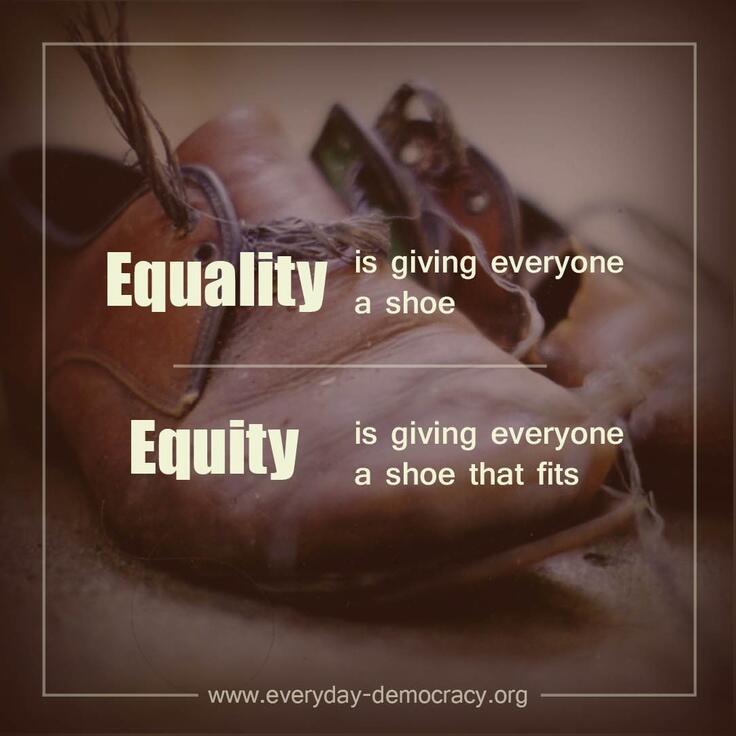
Equity vs. Equality in the Digital Divide

Equity vs. Equality in the Digital Divide


bzml8pgceaaprab-jpg-large.jpgIn most states, school funding formulas are fraught with politics and this has significant implications for technology infrastructure, devices, and opportunities.  The urban vs. rural digital divide surfaces in most states, especially as it relates to connectivity.  Many rural schools in my state (Oregon) struggle with getting enough bandwidth to do innovative and meaningful classroom learning.   When discussing home connectivity for students, some of my rural colleagues lament the cost of the middle and last miles and the struggle for reliable bandwidth and the lack of opportunities that this creates in comparison with most urban and suburban schools.

The urban vs. rural connectivity divide, though, is just part of the issue.   In many urban districts, schools are funded in a relatively equal manner.  However, monies flow into schools from parent organizations at a very different rate.  Rich schools can raise thousands of dollars at a drop of a hat while poor schools struggle to raise extra funds.  This can have serious implications for types of opportunities within the same district.  Wealthier schools can fund robotics clubs, lego programming experiences, engineering activities, computer labs, drones, etc. while poorer schools often cannot afford to offer these things.  From the school district's perspective, the schools are being funded equally, but the extra money that comes in makes for a much different educational experience.

Of course, parent contributions and volunteering in schools is a good thing as it means that the public is invested.  This should always be encouraged.  With that said, it can create vastly different learning environments between schools who are just a few miles apart.  

Portland Public Schools has taken on this problem of the great differences in parental contributions in their schools through the creation of the PPS Parent Equity Fund.  Portland is a district that has some very wealthy schools and some very poor schools.  The Equity Fund collects parent donations and allocates 1/3 of them to schools in need.   The wealthier schools still end up with more money for purchases at their schools as they keep the majority of funds that they raised.  With that said, at least some of the money that is raised ends up in schools where there is great need.  

Not everyone is happy with the redistribution of funds, especially some of the parents at wealthy schools.  This unhappiness has been documented in a thoughtfully written New York Times article.
Having a percentage of money taken away from a successful school campaign can cause frustration.  However, the inequities in many cities like Portland are significant.    There will always be a difference in resources and opportunities when comparing wealthier and poorer schools.  Portland's effort, though, at least acknowledges the opportunity gap that is created by disparate levels of giving.  Looking at school opportunities from a systemic district wide view is the least that educators can do when considering opportunity gaps.